Module 13 : Measurements on Fiber Optic Systems
Lecture     : Measurements on Fiber Optic Systems
  
  Attenuation (Loss) - Contd

From the delay of the back scattered we can find the location on the fiber.


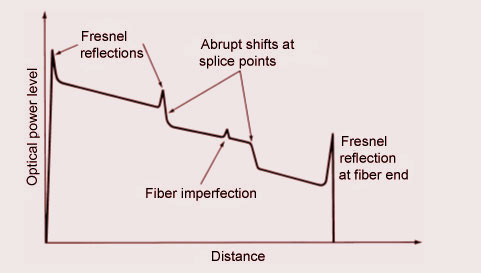
In addition to the Rayleigh back scattering, there could be local disturbance in the refractive index, like due to a splice or connector or a lossy bend. There will be stronger echo from these locations due to Fresnel reflections.

   
A typical back scatter intensity variation as a function of time is shown in Fig.
   
   
The slope of the line on the OTDR display gives twice the attenuation /Km of the fiber.
   

Since the Rayleigh scattering is very week in the optical fiber, the back scattered light intensity is very small to be detected in the presence of electrical noise. Multiple pulses are therefore transmitted and the received signal is integrated to improve the signal to noise ratio of the OTDR trace.


The separation between the pulses has to be more than the round trip delay on the fiber. If the maximum fiber length for which the OTDR is to be used is and its effective index is , the minimum separation of the pulses should be , where is the velocity of light in vacuum. The maximum pulse repetition frequency therefore is

 
The OTDR can also be used to monitor the status of the optical fiber while in operation. It can detect faults like tempering of the fiber as well as breakage in the fiber.
 

The accuracy with which the faults can be located depends upon the width of the optical pulse. The minimum separation needed between two identical faults to be identified as the two faults is called the resolution of the OTDR.


The resolution depends upon the laser pulse width as well as the dispersion on the fiber.

 
If the laser pulse width is , the pulse width of the received back scattered light will be

where is the dispersion on the fiber, is the spectral width of the laser and is the distance on the fiber.


The spatial resolution of the OTDR is

For short distance, the dispersion does not play much role and the resolution is independent of the distance. However, for longer lengths, the resolution worsens as a function of distance.

 
The most important aspect of the OTDR is, it requires access to only one end of the fiber and also it can monitor the fiber status on line while the fiber is in operation.