The attenuation of the optical fiber is one of the very important parameter as it has direct bearing on the length of the communication link. An accurate estimate of this parameter is very essential.
The optical loss has two components:
1)
Intrinsic loss in the fiber
2)
Loss due to the environment through which the fiber is laid.
The estimate of the intrinsic loss is obtained by the manufacturer. However, the second estimate has to be obtained by the user after the fiber is commissioned.
The second estimate takes into account the losses due to micro-bending, radiation etc. Whereas the first estimate takes into account the intrinsic absorption of the fiber and the Rayleigh scattering loss.
It should be noted that the loss measurement has to be carried out at the wavelength of operation.
The most commonly used instrument for the loss measurement is the Optical Time Domain Reflectometer (OTDR).
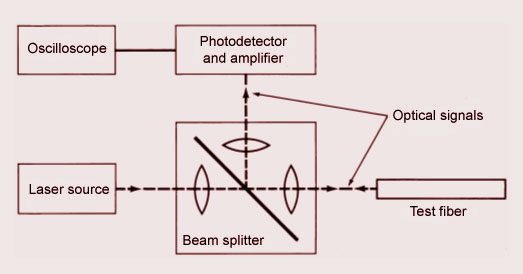
The basic set up of an OTDR is shown in Fig.
The OTDR is essentially an optical radar. The laser source launches a narrow pulse of light inside the optical fiber and measures its reflection.
The optical pulse when travels inside the fiber, gets Rayleigh scattred. The backward scattered light is collected by the photo-detector and displayed as a function of time.
Now the intensity of the Rayleigh scattered light depends upon (1) Intensity of the light propagating at that location (2) the variation in the refractive index at that location.
For a continuous fiber, the refractive index perturbation is same all along the fiber. The optical intensity however decreases along the fiber due to loss. The intensity of the back scattered light also then decreases in the same proportion. The back scattered travels along the fiber and gets further attenuated.
The intensity of the back scattered light then is proportional to twice the loss of the fiber.