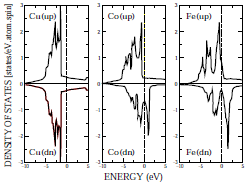
Figure 13.5: Density of states of Copper, Cobalt, and Iron. Dashed vertical line in the figure indicates the position of the Fermi Level.
On the other hand, the d band in the transition metals is occupied partially. Hence, the Fermi level in these metals intersects not only the conduction but also the d bands. Furthermore, the atomic wave functions of d levels are more localized than those of the outer s levels and therefore they overlap much less. This indicates that the d band is narrow and the corresponding density of states is high. This results an effective channel for scattering of conduction electrons into the d band.
Also, in the case of magnetic transition metals, one needs to consider that d bands for ↑ and ↓ spin electrons are split by the exchange interaction, and results almost in a rigid relative shift of the ↑ and ↓ spin d bands. As a consequence, the potentials seen by ↑ and ↓ electrons in a FM metal are different. This provides another mechanism of spin-dependent scattering which is specific to multilayers.
In addition, electrons in a multilayer entering the FM from the NM spacer see a spin dependent potential barrier which reflects differently electrons with ↑ and ↓ spin orientations. Therefore, one must seek as good a match as possible between the bands of the magnetic layers and those of the spacer layer in one spin channel and as large as possible mismatch in the other spin channel.