Since the ↑ and ↓ spin channels are independent (spin is conserved) they can be regarded as two wires connected in parallel. In addition, the electrons with spin projections parallel and antiparallel to the magnetization of the FM layer are scattered at different rates when they enter into FM. This is called spin-dependent scattering. Let us assume that electrons with spin antiparallel to the magnetization of the FM layer are scattered more strongly. The GMR effect in a trilayer can be now explained qualitatively using a simple resistor model as shown in Figure 13.3.
In the FM configuration, the electrons with ↑ spin are weakly scattered both in the first and second FM layers whereas the electrons with ↓ spin are strongly scattered in both FM layers. This can be simulated by two small resistors in the ↑ spin channel and by two large resistors in the ↓ spin channel in the equivalent resistor network shown in Figure 13.3a. Therefore, the resistance in FM configuration is determined by the low-resistance ↑ spin channel which shorts the high-resistance ↓ spin channel. On the other hand, in the AFM configuration, ↓ spin electrons are strongly scattered in the first FM layer but weakly scattered in the second FM layer. Similarly, the ↑ spin electrons are weakly scattered in the first FM layer and strongly scattered in the second. This is modeled in Figure 13.3b by one large and one small resistor in each spin channel. There is no shorting feasibility now and the total resistance in the AFM configuration is much higher than that in the FM configuration. This simple resistor model is believed to be correct but needs to be converted into a quantitative theory that can explain the differences between the CIP and CPP geometries, and the observed dependence of the GMR on the layer thicknesses and also the material.
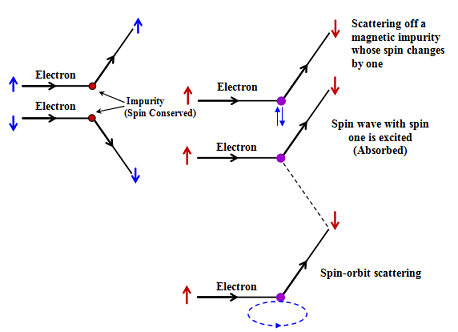
Figure 13.4: Schematic representation of different types of scattering in magnetic multilayers [4].