Objectives:
Novel magnetotransport phenomena such as giant magnetoresistance (GMR) (in magnetic multilayers) and tunnel magnetoresistance (TMR) (in ferromagnetic tunnel junctions) appear when the size scale of the magnetic materials becomes nanolevel. In particular, the subject of spintronics received wide attention with the discovery [1,2] that the electric current in a multilayer film, consisting of a sequence of thin magnetic layers separated by a thin non-magnetic metallic layer, is strongly influenced by the relative orientation of the magnetization of the magnetic layers. This suggests that the internal moment of the electrons associated with their spin plays an important role in the transport of electric charge. Therefore, it is required to understand the spin-dependent scattering process in magnetic multilayer structure and in the next two lectures, we will
1. Introduce the resistance change in multilayer structure,
2. Discuss the physical origin of GMR,
3. Demonstrate spin-dependent scattering of electrons in multilayer films, and
4. To derive equation for determining the GMR using resistor network theory.
(1) Resistance change in multilayer structure:
Figure 13.1 shows the typical multilayer structure consisting of a sequence of thin ferromagnetic (FM) layers separated by equally thin non-magnetic (NM) metallic layer. The resistance of the magnetic multilayer is low when the magnetizations of all the FM layers are parallel (see Figure 13.1a) and the resistance becomes larger when the magnetizations of the neighbouring FM layers are ordered antiparallel (Figure 13.1b).
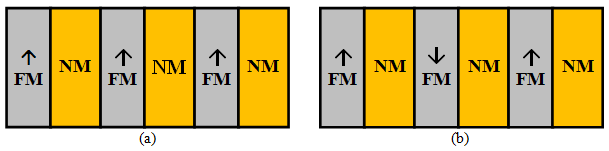
Figure 13.1: (a) Ferromagnetic and (b) antiferromagnetic configurations of magnetic multilayers film.
In the above scenario, the optimistic magnetoresistance (MR) ratio is defined by
