where R↑↓ and R↑↑ are the resistance of the multilayer film in antiferromagnetic (AFM) and FM configurations, respectively. The most commonly used combinations of magnetic and non-magnetic layers are Cobalt - Copper and Iron - Chromium. But multilayers based on permalloy (Ni80Fe20) as the magnetic component are also used frequently.
(2) Physical Origin of GMR:
There are two principal geometries of the GMR effect, which are schematically shown in Figure 13.2. In the first case (Figure 13.2a), the current flows perpendicular to the multilayers (CPP geometry), whereas in the Figure 13.2b the current flows in the plane of the layers (CIP). The underlying physical mechanism is the same for both the CPP and CIP geometries. For a simple demonstration, let us consider a trilayer magnetic film with two magnetic layers separated by a non-magnetic metallic spacer layer. The electron spin is conserved over distances of up to several tens of nanometers, which is much larger than the thickness of a typical multilayer. Therefore, one can assume that the electric current flows in two channels: one corresponding to electrons with spin projection ↑ and the other to electrons with spin projection ↓ [3].
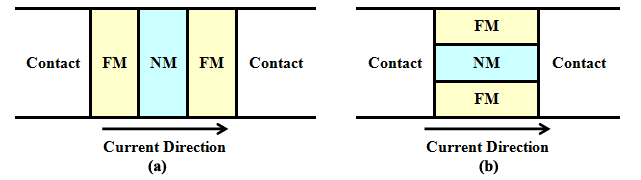
Figure 13.2: (a) Current perpendicular to plane (CPP) and (b) current in plane (CIP) GMR geometries.
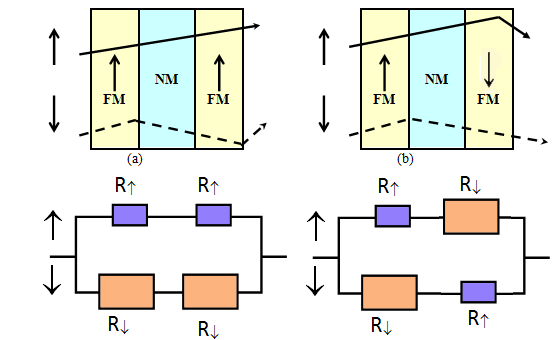
Figure 13.3: Schematic representations of simple resistor model for describing GMR.