Hence, we have
|
(27.8) |

The eqn.(27.8) clearly indicates that the MR is directly proportional to the polarization of the electrodes. This simple analysis roughly explains the pioneering experiments in spin tunnelling [3,4]. On the other hand, a more realistic theory includes two additional effects:
(1) The density of states at the Fermi level needs not be proportional to the total polarization.
(2) The wavefunctions of the majority and minority electrons near the barrier need not be the same. Then, the transmission coefficient acquires a spin dependence, which influences the MR.
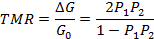
The TMR effect can also be demonstrated, if the spin polarization of the electrodes involved in the multilayer films is known [5]. Assuming the spin polarization of the two electrodes as P1 and P2, the relative resistance change is given as,
|
(27.9) |
The major challenges to use the spin dependent tunnel junctions in magnetic read heads are to reduce the junction resistance and optimize the multilayer structure for obtaining high TMR. The lowest junction resistance area reported to date is about 0.2 kΩ - μm2 , which is approaching close to the required values for MR read head applications [6]. Also, a large TMR of up to 600 % at room temperature and more than 1100 % at 4.2 K were observed in junctions of CoFeB/MgO/CoFeB [7], which is sensitive to the composition of the CoFeB [8]. This suggests that the research on spin dependent tunnelling is rapidly developing and more exciting results are expected in the future from the application point of view.
References:
[1]. J.S. Moodera et al, Phys. Rev. Lett. 74 (1995) 3273; J. Appl. Phys. 79 (1996) 4724.
[2]. R. Meservey and P.M. Tedrow, Phys. Rep. 238 (1994) 173.
[3]. M.H. Devoret and H. Grabert, "Single Charge Tunneling", Plenum Press, New York (1992).
[4]. J. M. D. Coey, A. E. Berkowitz, et al, Phys.Rev. Lett. 80 (1998) 3815.
[5]. M. Julliere, Phys. Lett. A 54 (1975) 225.
[6]. H. Tsuge et al, Res. Soc. Symp. Proc. 517 (1998) 87
[7]. S. Ikeda et al, Appl. Phys. Lett. 93 (2008) 082508.
[8]. M. Kodzuka et al, J. Appl. Phys. 111 (2012) 043913.