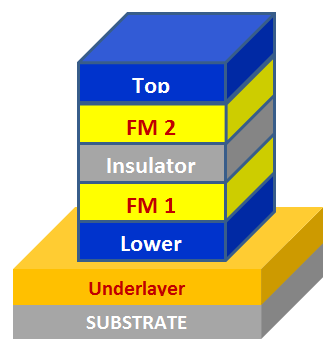
Moodera et al [1] proposed the room temperature spin-dependent tunnelling in a trilayer structure, consisting of a two ferromagnetic (FM) layers separated by a thin insulator, as depicted in Figure 27.1. When the insulator barrier is thin enough, the electrons can tunnel through the insulator from one of the FM layer to another or vice versa. In this scenario, the tunnelling current through the insulator is larger when both the FM layers are aligned parallel than when they are aligned antiparallel. This is called tunnelling magnetoresistance (TMR) effect.
|
Figure 27.1: Schematic presentation of a multilayer structure in TMR. |
In such case, the TMR can be written as
|
(27.1) |

where R↑↓ ( G ↑↓ ) and R ↑↑ ( G ↑↑ ) are the resistance (conductance) of the multilayer film in antiferromagnetic (AFM) and FM configurations, respectively.
|
|
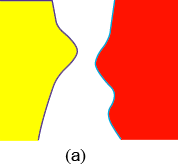
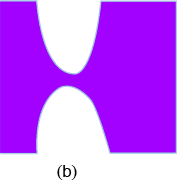
Figure 27.2: Schematic representations of a (a) tunnel junction and (b) contact junction . |
|
So, the TMR structure is similar to GMR, except the fact that the non-magnetic (NM) layer in GMR is replaced by an insulator in TMR. Hence, TMR is another subject of great interest. The spin dependent tunnelling poses many interesting challenges, but the number of applications for the magnetic tunnel junctions continues to grow [2]. Hence, it is essential to understand the physics behind the effect of magnetic fields on the current tunnelling through the magnetic junctions and to obtain the suitable equation to describe the TMR.