TMR Effect :
Note that we have not considered the magnetic properties of the electrodes in the above discussion. If the number of electrons of the two spin polarizations is not equal, we must define a spin dependent conductance, at each of the points where electrons move from one electrode to the other. The expressions defined earlier are modulated by the density of states of each type of electrons. For a given bias voltage V , the electrons which participate in the conduction come from the levels located, at most, at a distance eV from the Fermi energy, EF . Thus, in order to understand the transport at small bias voltages we need to know density of states at the Fermi level, D↑(EF ) and D↓ ( EF ). As discussed earlier, the tunnelling magnitude will be spin dependent, as shown in Figure 27.3.
|
Figure 27.3: schematic drawing of spin dependent tunnelling in FM/NM/FM junctions. |
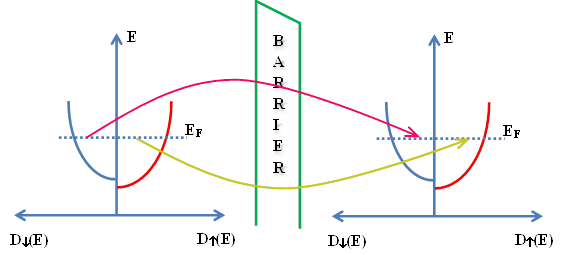
As the applied magnetic field modifies the polarization of the electrodes, the density of states also changes significantly. Further, the barrier can be described in terms of an energy dependent transmission coefficient. To simply the calculation, the direct magnetic coupling between the electrodes is negligible and the orientation of the magnetization in each electrode will be determined by bulk effects. This helps to assume that the relative orientation of the magnetization of the two electrodes can take any value. Therefore to calculate the magnetoresistance (MR) of the tunnel junction, we just need to compare the conductance with a random orientation of the magnetization of the electrodes and that when both magnetizations are aligned. Further, we assume that
|
(27.5) |


where N↑ and N↓ are the number of electrons with down and up spin. Subsequently, in the unpolarized situation, we may expect that
|
(27.6) |


where the indices L and R stands for the left and right electrodes, and NL and NR are the total number of electrons. On the other hand, in the polarized case, we have:
|
(27.7) |
