Four-probe method:
Van der Pauw method:
This method involves applying a current and measuring voltage using four small contact on the circumference of a flat, arbitrarily shaped sample of uniform thickness.
The resistivity can be obtained from a total of eight measurements that are made around the periphery of the sample with the configurations as shown in Figure 25.04.
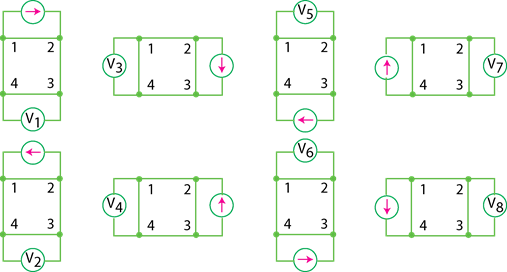
Figure 25.04: Schematic of different configurations involved in van der Pauw method.
Once all the voltages are taken, two values of resistivity ρA and ρB can be derived as follows: