Atomic Force Microscope: Imaging Modes
Non-contact Mode:
• The tip of the cantilever does not contact the sample surface as shown in Figure 19.06 and the cantilever is oscillated at either its resonant frequency (frequency modulation) or just above (amplitude modulation) where the amplitude of oscillation is typically a few nanometers (<10 nm) down to a few picometers. The van der Waals forces, which are strongest from 1 nm to 10 nm above the surface, or any other long-range force that extends above the surface acts to decrease the resonance frequency of the cantilever. This decrease in resonant frequency combined with the feedback loop system maintains a constant oscillation amplitude or frequency by adjusting the average tip-to-sample distance. Measuring the tip-to-sample distance at each (x,y) data point allows the scanning software to construct a topographic image of the sample surface.
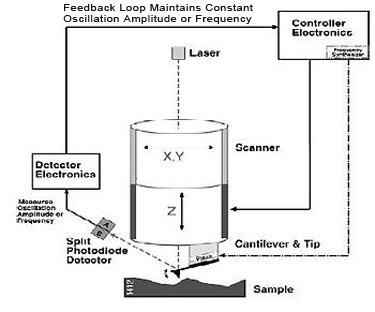
Figure 19.06: Schematic of non-contact mode imaging [3].
• Non-contact mode does not suffer from tip or sample degradation effects, which makes non-contact AFM preferable for measuring soft samples, e.g., biology sample and organic thin film. In the case of rigid samples, contact and non-contact images may look the same. However, if a few monolayers of adsorbed fluid are lying on the surface of a rigid sample, the images may look quite different. An AFM operating in contact mode will penetrate the liquid layer to image the underlying surface, whereas in non-contact mode an AFM will oscillate above the adsorbed fluid layer to image both the liquid and surface.
• In amplitude modulation, changes in the oscillation amplitude or phase provide the feedback signal for imaging. Hence, changes in the phase of oscillation can be used to discriminate between different types of materials on the surface. This can be operated either in the non-contact or in the intermittent contact regime. In dynamic contact mode, the cantilever is oscillated such that the separation distance between the cantilever tip and the sample surface is modulated. This has also been used in the non-contact regime to image with atomic resolution by using very stiff cantilevers and small amplitudes in an ultra-high vacuum environment.
Ref.[3]. http://en.wikipedia.org/wiki/File:AFM_noncontactmode.jpg.