Electron-Atom Interaction:
• In all the cases, the incoming primary electrons can be scattered elastically or in-elastically.
• The interactions include the excitation of inner shell electrons, the creation of plasmons and interactions with single valence electrons, the excitation of a phonon.
• We have shown the formation of various processes in the earlier slides for each incoming primary electron separately. However, the subsequent relaxation of inner shell excited atoms may occur by the emission of an X-ray or an Auger electron.
Overall interaction between the electron and specimen
Figures 12.01 summarize the electron, X-ray and light signals generated by the interaction between electron beam and specimen. The component elements can be analyzed by measuring the characteristics X-rays with an energy dispersive X-ray spectroscopy (EDS). While backscattered, Auger, secondary electrons, etc., occur, a part of the electron beam pass through the specimen for its thin thickness. Electron Energy Loss Spectroscopy (EELS) allows to detect the bonding information of the specimen.
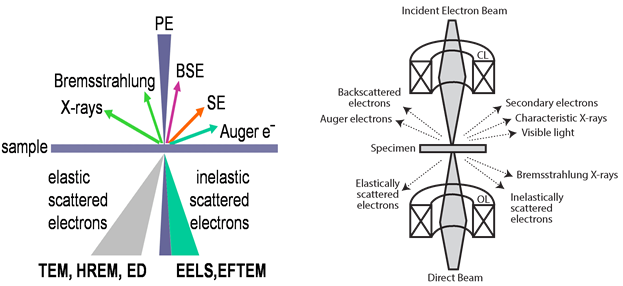
Figure 12.01: Products of electron and atom interaction.