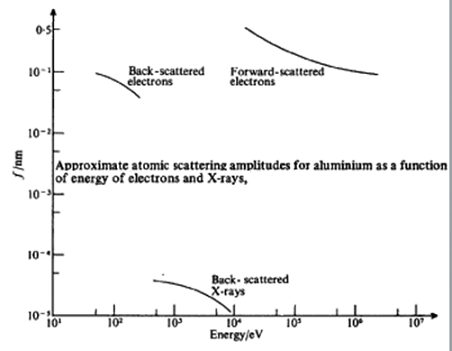
Figure 8.06: Atomic scattering amplitude for aluminium as a function of energy of electrons and X-rays.
LEED: (a) A well developed theory exists and hence quantitative analysis is possible. (b) Provides information not only in-plane but also out-of-plane. Diffraction pattern: spots. Disadvantage is the normal incidence to the sample surface.
RHEED: (a) Theory is not well developed as compared to LEED, (b) includes multiple scattering events and many more inelastic events; (c) quantitative analysis is usually not performed. Diffraction pattern: streaks; sensitive to roughness, surface must be very flat.
Quiz 8:
(Q8.1). What is the range of kinetic energy used in RHEED?
(Q8.2). What is Ewald's sphere?
(Q8.3). Why do we observe streaks in real smooth surface instead of spots?
(Q8.4). What are the advantages and disadvantages of RHEED over LEED?