RHEED: Principle of operation:
• As RHEED is typically based on the reflection of electrons with high kinetic energy (~ 5 - 100 keV) and low impact angle (< 5°) from the surface of a solid, a brief illustration of the operation principle for a cubic lattice sample is described below using Figure 8.02:
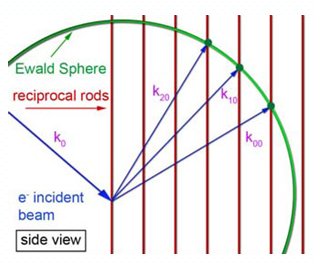
Figure 8.02: Schematic of operation principle of RHEED.
• The side view is shown in the figure 8.02. In reciprocal space, the two-dimensional array of the surface atoms turns into vertical lines, i.e., the reciprocal rods. The condition for constructive interference of the elastically scattered electron beams from the surface is fulfilled whenever these rods cross the Ewald sphere, as shown in figure.
• Figure 8.03 shows the directions of elastically scattered electrons in real space. The scattered electrons hit a fluorescent screen in certain spots, lying on so-called Laue circles, which are numbered starting from zero (red) and 1 (cyan).