Preferred Orientation (texture):
• The materials characteristics such as conductivity, thermal expansivity and hardness differ in each of the crystal directions.
• Most of the industrial materials possess polycrystalline nature and preferred orientation in the materials gives rise to any small change in the fabrication process.
• Therefore, the understanding of texture in the materials is very much important. This can be represented using pole figure, in which the existence of any number of crystallites in a specific crystallographic axis is plotted by a stereographic projection.
• A pole figure is closely examined whether or not the crystal grains in the plane are regularly aligned.
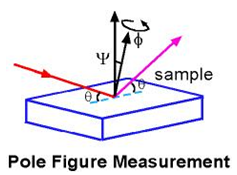
• Figure 5.06 shows the diffractometer set up and sample movement in pole figure measurement. In the XRD set up, the sample and X-ray detector can be moved at θ and 2θ, respectively.
• After fixing θ or 2θ in a particular Bragg's condition for the sample as shown in Figure 5.07, the pole figure measurement is undertaken by rotating the sample holder along the two-axes of Ψ and Φ. Ψ is varied at 0 - 90°, and Φ is adjusted from 0 - 360° for each value of Ψ as shown in Figure 5.06.
 |
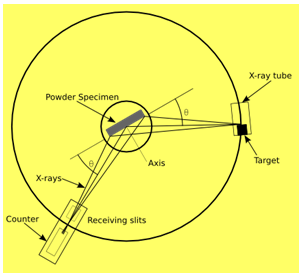 |
Figure 5.06: Schematic of XRD setup for texture analysis.