2. Thermodynamic Stability, positive response function and convexity of free energy:
Free energy functions are often found a concave or a convex function of thermodynamic parameters. A function  is called a convex function of x if

That is to say, the chord joining the points  and
and  lies above or on the curve for all x in the interval
  for a convex function. Similarly, a function is called a concave function of x if

Thus, for a concave function, the chord joining the points and lies below or on the curve for all x in the interval . If the function is differentiable and the derivative  exists, then a tangent to a convex function always lies below the function except at the point of tangent whereas for a concave function it always lies above the function except at the point of tangency. If the second derivative exists, then for a convex function
  and for a concave function
  for all x
On the other hand, thermodynamic response functions such as specific heat, compressibility, susceptibility (for ferromagnetic systems) are found to be positive and the positive values of the response function implies the convexity properties of the free energy functions such as  or
or  .
.
The positive response function is a direct consequence of Le Chatelier's principle for stable equilibrium. The principle says, if a system is in thermal equilibrium any small spontaneous fluctuation in the system parameter, the system gives rise to certain processes that tends to restore the system back to equilibrium. Suppose there was a spontaneous temperature fluctuation in which the temperature of the system increases from T to  . In order to maintain the stability, the system should absorb certain amount of heat
  and as a consequence the specific heat
  must be positive since both and
  are positive. If there occurs a spontaneous pressure fluctuation,
  and
and  , then the system will reduce its volume by certain amount
  to maintain the stability. As a consequence the compressibility
  is also to be positive since
  is positive but is negative. Thus, for thermally and mechanically stable fluid system, the specific heat and compressibility should be positive for all T. However, for a magnetic system such arguments that the susceptibility χ and specific heat C both are positive can not be made. It is known that for diamagnetic materials, χ<0. The ferromagnetic materials on the other hand have positive χ. It can be shown that such systems are described by the Hamiltonian
 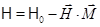 .
.