7. Speed control
For an actuator, the operational speed is determined by the fluid flow rate and the cylinder actuator area or the motor displacement. The speed can only be controlled by adjusting the fluid flow to the actuator, because the physical dimension of the actuator is fixed. Since the air is compressible, flow control is difficult as compared to the hydraulic system. There are various ways of controlling the fluid flow. One of the methods is discussed as below
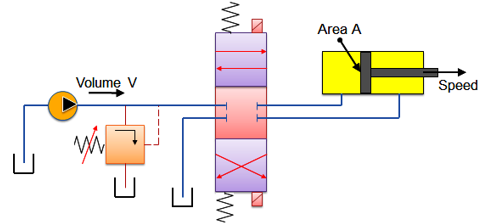
Fig. 6.4.7 Speed control by pump volume
Figure 6.4.7 shows the circuit diagram of hydraulic system developed to control the speed of motion of a piston. Consider a pump which delivers a fluid volume of ‘V’ per minute. The pump has a fixed displacement. The volume of fluid goes either to the pump or to the actuator. When the direction control valve moves from its center position the actuator of area ‘A’, the piston moves with a velocity,
|
(6.4.1) |

If the pump delivery volume ‘V’ can be adjusted by altering swash plate angle of a piston pump or by using a variable displacement vane pump, no further speed control will be needed.