Actuators are output devices which convert energy from pressurized hydraulic oil or compressed air into the required type of action or motion. In general, hydraulic or pneumatic systems are used for gripping and/or moving operations in industry. These operations are carried out by using actuators.
Actuators can be classified into three types.
- Linear actuators: These devices convert hydraulic/pneumatic energy into linear motion.
- Rotary actuators: These devices convert hydraulic/pneumatic energy into rotary motion.
- Actuators to operate flow control valves: these are used to control the flow and pressure of fluids such as gases, steam or liquid.
The construction of hydraulic and pneumatic linear actuators is similar. However they differ at their operating pressure ranges. Typical pressure of hydraulic cylinders is about 100 bar and of pneumatic system is around 10 bar.
1. Single acting cylinder
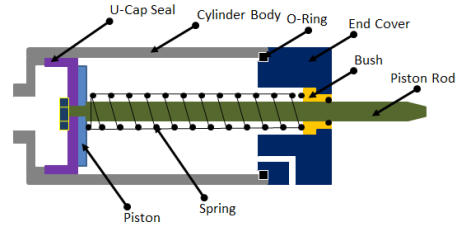
Fig. 6.4.1 Single acting cylinder
These cylinders produce work in one direction of motion hence they are named as single acting cylinders. Figure 6.4.1 shows the construction of a single acting cylinder. The compressed air pushes the piston located in the cylindrical barrel causing the desired motion. The return stroke takes place by the action of a spring. Generally the spring is provided on the rod side of the cylinder.