3. Cylinder end cushions
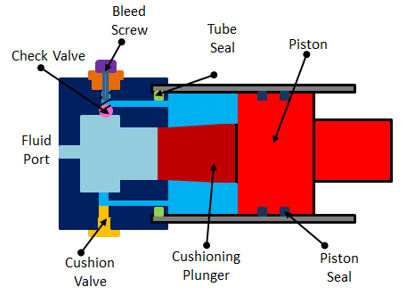
Fig. 6.4.3 Cylinder end cushioning
Double acting cylinders generally contain cylinder cushions at the end of the cylinder to slow down the movement of the piston near the end of the stroke. Figure 6.4.3 shows the construction of actuating cylinder with end cushions. Cushioning arrangement avoids the damage due to the impact occurred when a fast moving piston is stopped by the end caps. Deceleration of the piston starts when the tapered plunger enters the opening in the cap and closes the main fluid exit. This restricts the exhaust flow from the barrel to the port. This throttling causes the initial speed reduction. During the last portion of the stroke the oil has to exhaust through an adjustable opening since main fluid exit closes. Thus the remaining fluid exists through the cushioning valve. Amount of cushioning can be adjusted by means of cushion screw. A check valve is provided to achieve fast break away from the end position during retraction motion. A bleed screw is built into the check valve to remove the air bubbles present in a hydraulic type system.