4. Pump Lift
In general, the pump is placed over the fluid storage tank as shown in figure 5.1.5. The pump creates a negative pressure at the inlet which causes fluid to be pushed up in the inlet pipe by atmospheric pressure. It results in the fluid lift in the pump suction. The maximum pump lift can be determined by atmospheric pressure and is given by pressure head as given below:
| Pressure Head, P = ρgh | (5.1.1) |
Theoretically, a pump lift of 8 m is possible but it is always lesser due to undesirable effects such as cavitation. The cavitation is the formation of vapor cavities in a liquid. The cavities can be small liquid-free zones ("bubbles" or "voids") formed due to partial vaporization of fluid (liquid). These are usually generated when a liquid is subjected to rapid changes of pressure and the pressure is relatively low. At higher pressure, the voids implode and can generate an intense shockwave. Therefore, the cavitation should always be avoided. The cavitation can be reduced by maintaining lower flow velocity at the inlet and therefore the inlet pipes have larger diameter than the outlet pipes in a pump. The pump lift should be as small as possible to decrease the cavitation and to increase the efficiency of the pump.
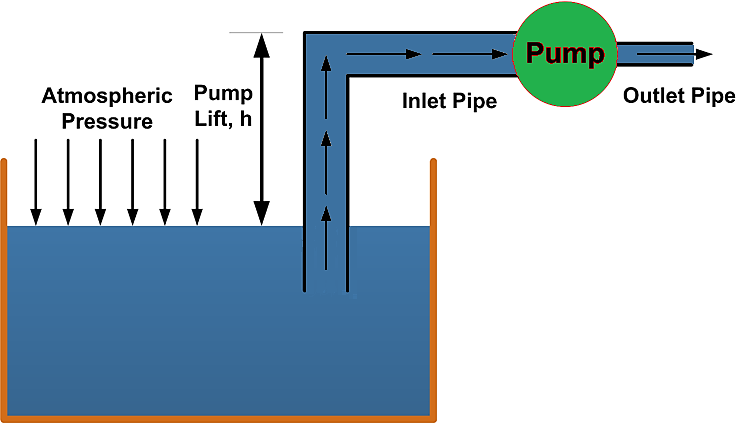
Figure 5.1.5 Pump lift