2. Applications of hydraulic systems
The hydraulic systems are mainly used for precise control of larger forces. The main applications of hydraulic system can be classified in five categories:
2.1 Industrial: Plastic processing machineries, steel making and primary metal extraction applications, automated production lines, machine tool industries, paper industries, loaders, crushes, textile machineries, R & D equipment and robotic systems etc. 2.2 Mobile hydraulics: Tractors, irrigation system, earthmoving equipment, material handling equipment, commercial vehicles, tunnel boring equipment, rail equipment, building and construction machineries and drilling rigs etc. 2.3 Automobiles: It is used in the systems like breaks, shock absorbers, steering system, wind shield, lift and cleaning etc. 2.4 Marine applications: It mostly covers ocean going vessels, fishing boats and navel equipment. 2.5 Aerospace equipment: There are equipment and systems used for rudder control, landing gear, breaks, flight control and transmission etc. which are used in airplanes, rockets and spaceships. |
3. Hydraulic Pump
The combined pumping and driving motor unit is known as hydraulic pump. The hydraulic pump takes hydraulic fluid (mostly some oil) from the storage tank and delivers it to the rest of the hydraulic circuit. In general, the speed of pump is constant and the pump delivers an equal volume of oil in each revolution. The amount and direction of fluid flow is controlled by some external mechanisms. In some cases, the hydraulic pump itself is operated by a servo controlled motor but it makes the system complex. The hydraulic pumps are characterized by its flow rate capacity, power consumption, drive speed, pressure delivered at the outlet and efficiency of the pump. The pumps are not 100% efficient. The efficiency of a pump can be specified by two ways. One is the volumetric efficiency which is the ratio of actual volume of fluid delivered to the maximum theoretical volume possible. Second is power efficiency which is the ratio of output hydraulic power to the input mechanical/electrical power. The typical efficiency of pumps varies from 90-98%.
The hydraulic pumps can be of two types:
- centrifugal pump
- reciprocating pump.
Centrifugal pump uses rotational kinetic energy to deliver the fluid. The rotational energy typically comes from an engine or electric motor. The fluid enters the pump impeller along or near to the rotating axis, accelerates in the propeller and flung out to the periphery by centrifugal force as shown in figure 5.1.3. In centrifugal pump the delivery is not constant and varies according to the outlet pressure. These pumps are not suitable for high pressure applications and are generally used for low-pressure and high-volume flow applications. The maximum pressure capacity is limited to 20-30 bars and the specific speed ranges from 500 to 10000. Most of the centrifugal pumps are not self-priming and the pump casing needs to be filled with liquid before the pump is started.
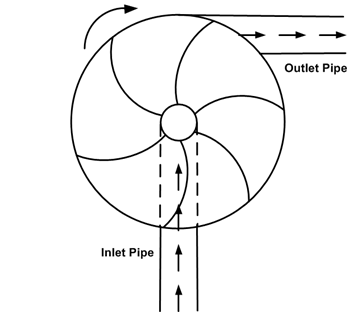
Figure 5.1.3 Centrifugal pump
The reciprocating pump is a positive plunger pump. It is also known as positive displacement pump or piston pump. It is often used where relatively small quantity is to be handled and the delivery pressure is quite large. The construction of these pumps is similar to the four stroke engine as shown in figure 5.1.4. The crank is driven by some external rotating motor. The piston of pump reciprocates due to crank rotation. The piston moves down in one half of crank rotation, the inlet valve opens and fluid enters into the cylinder . In second half crank rotation the piston moves up, the outlet valve opens and the fluid moves out from the outlet . At a time, only one valve is opened and another is closed so there is no fluid leakage. Depending on the area of cylinder the pump delivers constant volume of fluid in each cycle independent to the pressure at the output port.
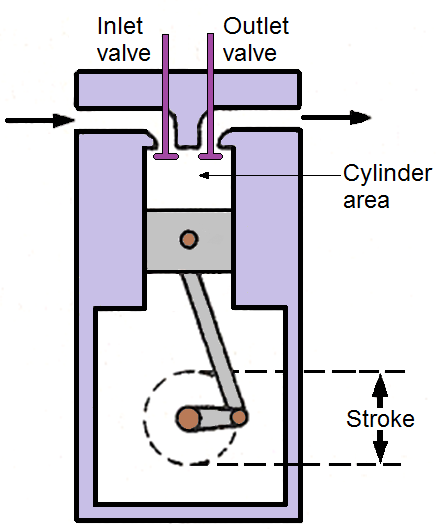
Figure 5.1.4 Reciprocating or positive displacement pump