2.2 Dervation of the conservations equations.
In order to reduce the complexity of the problems, assumptions are made during the formulation of the problem. Some of the fundamental assumptions made in the gas dynamics analysis are given below:
- Continnum
- No chemical changes
- The gas is perfect.
- The fluid is single phase.
- Gravitational effects on the flow field are negligible.
- Magnetic and electric effects are negligible.
- Viscosity is negligible.
2.2.1 Conservation of Mass or Continuity Equation (Integral Form)
Conside the fluid domain as shown in the following figure (2.1). Our aim is to derive the mass conservation equation using this fluid domain of arbitary shape.
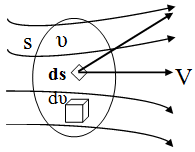
Fig. 2.1. Finite Control Volume fixed in space
If there is no mass source in the control volume, we can equate the rate of change of mass inside the control volume with the difference in influx and outflux of mass. Consider ρ as the density of the flow which is function of space coordinates and time (ρ = ρ(x, y, z, t)) . Let V be velocity vecotor of the flow which is also function of space coordinates and time and has u, v and w as three components aligned to the coordinate axes x, y and z respectively. Consider elemental surface area (dS) of the control volume. This area along with the unit normal is shown in Fig. (2.1).
Total mass inside the control volume can be found by summing the mass of elemental volumes (dv) occuping the complete finite volume. We know that ρdυ is the mass of an elemental volume, hence total mass inside the control volume can be written as
Total mass in the control volume (CV) =
Hence rate of change of this mass is,
Rate of change of mass in CV= 
Thus the time rate of decrease of mass inside the CV is
|
(2.3) |

The mass flow rate of any moving fluid across any fixed surface is equal to the product of density, area of surface and component of velocity normal to the surface. Therefore, the elemental mass flow across the area ds is expressed as
ρVndS = ρV.dS |
(2.4) |
Where Vn is the component of velocity normal to the surface. Thus the net mass flow out of the entire volume through the control surface S is summation of mass flow rates through all elemental areas dS of control surface S shown in Fig. (2.1). Hence net flux through the control surface is
|
(2.5) |

Here mass flux entering the CV is negative and massflux leaving the CV is positive. Therefore eq. (2.5) gives the net mass leaving the CV which should be equal to rate of decrease of massflux in the CV. Thus, equating equations (2.3) and (2.5), we get,
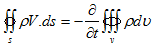
or,
|
(2.6) |
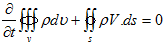
Equation (2.6) is called as integral form of mass conservation equation or continuity equation.
2.2.2 One dimentional form of Mass conservation or Continuity Equation
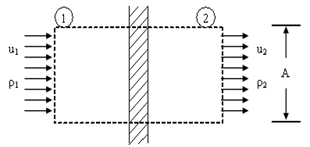
Fig. 2.2. One-dimensional flow
For steady flow Equation (2.6) becomes

Applying the surface integral over the control volume of Fig. (2.2), this equation becomes
- ρ1u1A + ρ2u2A = 0
or
ρ1u1 = ρ2u2 |
(2.7) |
For flow over the varying cross-sectional area such as nozzle and diffuser, equation (2.13) modifies to
ρ1u1A1 = ρ2u2A2 |
(2.8) |