Intersection of Cone and Cylinder
Figure 5 illustrate the cutting plane method for obtaining the curve of intersection. In this the top view of the cone after sectioning will be a circle and that of the cylinder will be a rectangle with width W. The diameter of the circle and the width of the rectangle in the top view will depend on the height of the section from the cone base. At each height, the intersection points P2, P3, P4 … are obtained and finally these points are joined by a smooth curve in the front view.
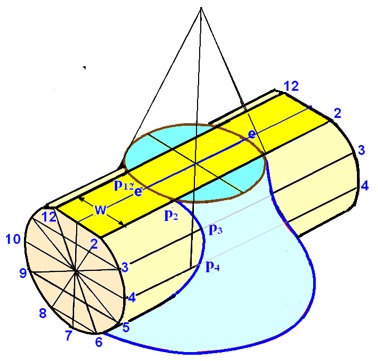
Figure 5 illustrating the cutting plane method for obtaining the curve of intersection.
Problem 3
Example - A vertical cone, diameter of base 75 mm and axis 100 mm long, is completely penetrated by a cylinder of 45 mm diameter. The axis of the cylinder is parallel to HP and VP and intersects the axis of the cone at a point 22 mm above the base. Draw the projections of the solids showing curves of intersection.
Solution
Draw lines dividing the surface of the cylinder into twelve equal parts.
Assume a horizontal cutting plane passing through say, point 2. The section of the cylinder will be a rectangle of width w (i.e. the line 2-12), while that of the cone will be a circle of diameter ee. These two sections intersect at points p2 and p12. These sections are clearly indicated in the top view by the rectangle 2-2-12-12 and the circle of diameter ee. In the front view, the cutting plane is seen as a line coinciding with 2' 2’. Points p2 and p12 when projected on the line 2' 2’ (with which the line 12'-12' coincides) will give a point p2' (with which p12' will coincide). Then p2' and p12' are the points on the curve of intersection. To obtain the points systematically, draw circles with centre 0 and diameters dd, ee, ff,etc. cutting lines through 1, 2 and 12, 3 and 11 etc. at points p1, p2 and p12, p3 and pll etc . Project these points to the corresponding lines in the front view.
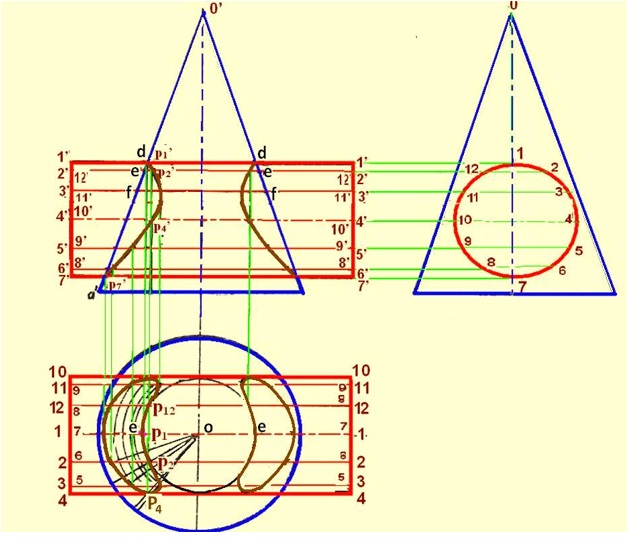
Figure 6. solution to problem 3.