Shortest distance between two lines
Two lines may be parallel, or intersecting, or non-parallel and non-intersecting.
When the lines are intersecting, the point of intersection lies on both the lines and hence these lines have no shortest distance between them.
Non-parallel and non-intersecting lines are called Skew Lines.
The parallel lines and the skew lines have a shortest distance between them.
The shortest distance between the two lines is the shortest perpendicular drawn between the two lines.
Shortest distance between two parallel lines
The shortest distance between two parallel lines is equal to the length of the perpendicular drawn between them.
If its true length is to be measured, then the two given parallel lines should be shown in their point views.
If the point views of the lines are required, then first they have to be shown in their true lengths in one of the orthographic views.
If none of the orthographic views show the given lines in their true lengths, an auxiliary plane parallel to the two given lines should be set up to project them in their true lengths on it.
Even the auxiliary view which shows the lines in their true lengths may not show the perpendicular distance between them in true length. Hence another auxiliary plane perpendicular to the two given lines should be set up. Then the lines appear as points on this auxiliary plane and the distance between these point views will be the shortest distance between them.
Shortest distance between two parallel lines
Problem: 3
Projections of a pair of parallel lines AB and PQ are shown in figure 5. ab and a'b' are the top and front views of the line AB. pq and p'q' are the top and front views of the line PQ. Determine the Shortest distance between the two lines.
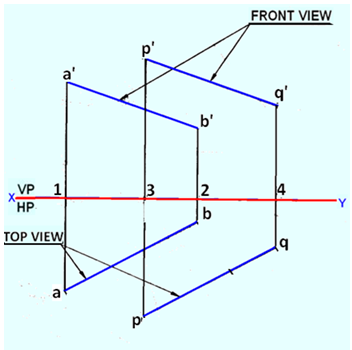
Figure 5. The projections of lines AB and PQ for problem 3.
Solution:
Since the top and front views of the lines are inclined to the XY line, neither the top view nor the front view show the lines in their true lengths. To show these lines in their true lengths, an auxiliary plane, parallel to the two given lines, should be set up parallel to the projections of the lines either in the top view or front view. In this case the auxiliary plane is set up so as to be parallel to the two given lines in top view. The method of determining the shortest distance between the two lines is shown in figure 6.