Problem 2
A line AB 60 mm long has one of its extremities 60 mm infront of VP and 45 mm above HP.
The line is inclined at 300 to HP and 450 to VP. Draw the projections of the line by the auxiliary plane method.
Solution. The solution is shown in figure . The method of obtaining the projections is described below.
Let A be one of the extremities of the line AB at distance 60 mm in front of VP and 45 mm above HP.
Mark a1 and a1’ the top and the front views of the extremity A.
Initially the line is assumed to be parallel to HP and VP.
a1b1 and a1’ b1’ are the projections of the line in this position.
Then instead of rotating the line so as to make it inclined to both the planes, an AIP is set up at an angle θ, which the line is supposed to make with HP and the auxiliary top view is projected on it.
To draw the Auxiliary Top View on AIP
Draw X1Y1 line inclined at θ = 300 to the XY line. Mark AIP and VP. Project the auxiliary top view ab The projections ab on the AIP and a1'b1' on VP are the auxiliary view and the front view of the line when it is inclined at θ to HP and parallel to VP.
Since the line is inclined at true inclination Φ to VP, to project the auxiliary front view an AVP inclined at Φ to VP should be setup.
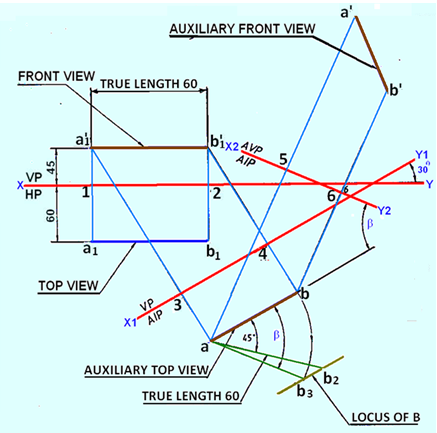
Figure 4. Projection of line AB (problem 2) by auxiliary projection mentod.
To draw the Auxiliary F.V. on AVP
Already the line is inclined at θ to AIP and parallel to VP. If the line is to be inclined at Φ to VP, an AVP inclined at Φ to the given line should be setup. But we know that when a line is inclined to both the planes, they will not be inclined at true inclinations to the XY line, instead they will be at apparent inclinations with the XY line. Therefore X2Y2, the line of intersection of AIP and AVP cannot be drawn directly at Φ to ab.
The apparent inclination bof abwith the X2Y2 line should be found out. To find b, through a draw ab2 equal to 60 mm, the true length of AB inclined at Φ = 450 to ab.
Through b2, draw the locus of B parallel to X1Y1 line. With center aandradius ab strike an arc to intersect the locus of B at b3.
Connect ab3 and measure its inclination b with ab. Now draw the X2Y2 line inclined at b to ab. Mark AVP and AIP on either side of X2Y2.
Project the auxiliary front view a’b’. ab and a’b’ are the required projections.