Fermi-Dirac (F - D) statistics
Fermi-Dirac statistics is based on the Pauli's exclusion principle. According to this principle, no two electrons having same spin can occupy the same energy level.
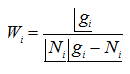
If we allow not more than one particle per quantum state, then it is necessary that gi ≥ Ni and particles governed by this restriction are called Fermions. Of the gi quantum states in an energy level εi , Ni states are occupied and (gi - Ni) states are empty. The problem thus consists of counting the number of ways in which gi quantum states can be divided into two groups, with occupied states in one group and the empty one in the other.
∴ Thermodynamic probability of energy level εi is
|
(5.112) |
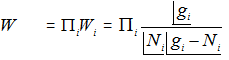
For all energy levels,
|
(5.113) |


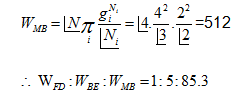
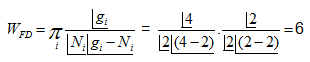
Example: Compare the Fermi-Dirac, Bose-Einstein and Maxwell-Boltzmann statistics when 4 particles are arranged in two energy levels. Two particles are at energy level ε1 having a degeneracy g1 = 4 and other two particle at energy level ε2 having a degeneracy g1 = 2.
Solution:
Fermi-Dirac Model:
Bose-Einstein Model

Maxwell-Bolzmann Model