Different heat loads are shown in Table 1.16
Table 1.16 Cooling and heating above and below 23.5°C pinch point.
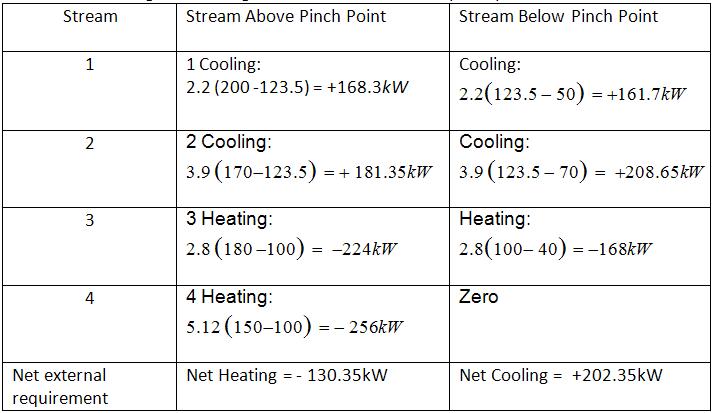
From Table 1.16, mathematically with reference to
the Fig 1.37 we can infer that for a pinch point of
23.5°C, we require external heating load
of 130.35kW and cooling load of 202.35kW above and
below the pinch point respectively.
The process integration is now as follows:
Above pinch point, stream 1 and 3 exchanges 168.3 kW heat, stream 2 and stream
4 exchanges 181.35kw. Below pinch point, stream 2 and stream 3 exchange 168
kW heat. Stream 3 and 4 are to be externally heated with (224-168.3 = 55.7
kW) and (256-181.35 = 74.65 kW) respectively to meet the deficit /demand of
130.35 kW. Similarly, stream 1 and 3 are to be cooled externally with 161.7
kW and (208.65-168 = 40.65 kW) heat exchangers respectively to meet the demand
of 202.35 kW.
Possible processes are shown in Fig. 1.38.
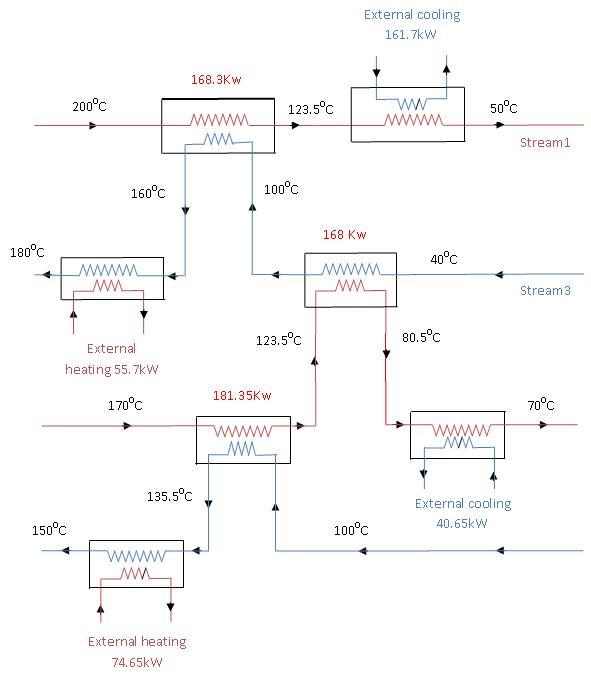
Fig 1.38 Possible plant to heat and cool four fluid streams for a minimum 23.5°C temperature difference.
The following rules should be followed in process integration
- Do not transfer heat from one fluid to another across the pinch point
- No external heating below pinch point
- No external cooling above the pinch point
- A heat exchanger should operate on one side of the pinch, either taking a heat supply from below the pinch, or rejecting heat to a fluid above the pinch
- A heat pump should operate across the pinch from a cold stream below the pinch to a hot stream above the pinch.
Summary:
- Exergy is the maximum work potential of a system
- Exergy transfer with heat, work and mass
- For an isolated system exergy always decreases
- Exergy remains constant in a reversible process
Anything that generate entropy is responsible for decrease of exergy