- A method of using the overall thermal balance of a process
- Theoretically predicts minimum energy consumption
- Predicts the construction costs of the plant using a heat recovery system
- First put into practical use in 1984, at Linhoff March Co.
Pinch point technology, or process integration, is
the name given for a technique developed by Prof.
Linnhof and co-workers (1978) at Leeds University,
UK to optimize the heat recovery in large complex
plants with several hot and cold streams of fluids.
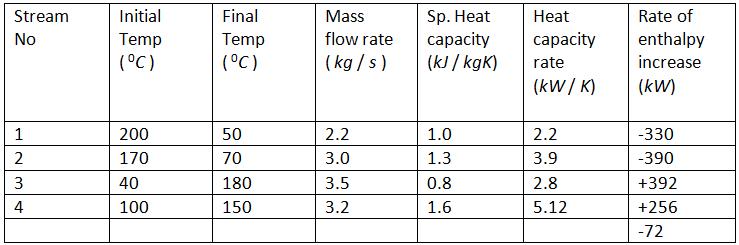
To illustrate the basic principle take a case of a
plant with two hot and two cold streams, as shown
in Table 1.9.
Table 1.9 Data for 4 (four) fluid streams
The hot streams can be combined into
an equivalent composite stream as follows:
From Table 1.9, it is clear that both stream 1 and
2 are having common temperature drop between 170°C
to 70°C. For the common processes, we go for process
integration (heat recovery) by considering composite
thermal capacity.
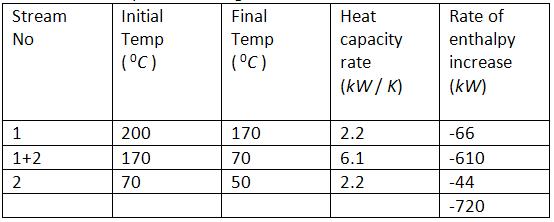
The hot composite curve will consists of the following
- Stream1 from 200°C to170°C with heat capacity 1.98 kW/K,
- Stream (1+2) between temperature 170°C to 70°C, a combined stream of thermal capacity rate (2.2+3.9) = 6.1 kW/K
- Stream2 between temperature 70°C to 50°C, stream 1 with heat capacity rate 1.98 kW/K.
To plot the composite heating curve the calculations can be estimated as shown in Table 1.10.
Table 1.10 Composite Heating Curve