The pinch point is defined as the point where temperature difference between the two composite curves is minimum.
The temperature difference at the pinch point depends on the design of the heat exchanger. Smaller the temperature difference, the more expensive is the heat exchanger. A high value of pinch point indicates high thermal losses due to external irreversibility.
Example 1: Pinch point temperature of 7°C
Pinch point temperature of 7°C, then the cold stream (composite) can be moved from left to right on the diagram horizontally, keeping the hot composite curve fixed, until the temperature difference at pinch point is 7°C. It is then seen from Fig 1.35 that the external heating load of 30 kW and external cooling load of 102kW are required for the system, all other energy changes can be achieved by the heat exchangers between the various streams.
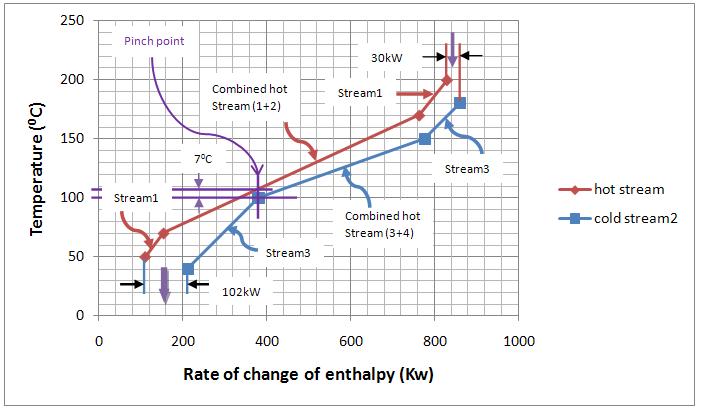
Fig 1.35 Temperature verses rate of change enthalpy change for composite hot and cold streams for 7°C Pinch
Mathematically to obtain the pinch point at 7°C the values of cold steams are increased by 100KW, keeping the values of hot streams constant. Required estimation of hot and cold streams for 7°C pinch point is given in Table. 1.13.
Table 1.13 Estimation of hot and cold streams for 7°C pinch point
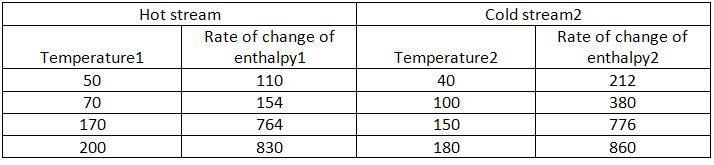
The mathematically the cooling and heating above and below 7°C Pinch point is mentioned in Table 1.14.
Table 1.14 Cooling and heating above and below 7°C pinch point
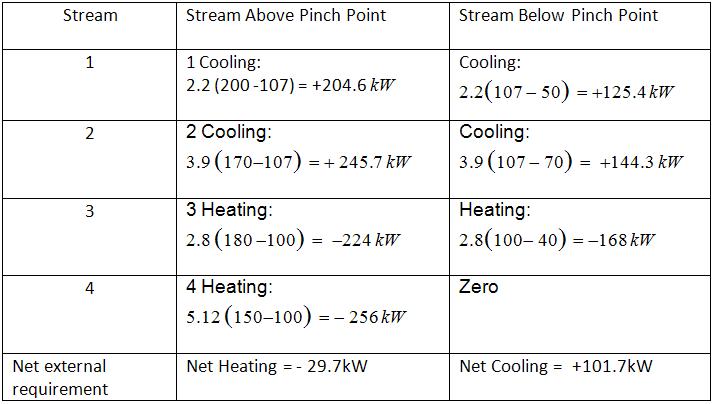
From Table 1.14, and Fig 1.35 we can infer that for
a pinch point of 7°C, we require external heating
load of 29.7kW and cooling load of 101.7kW above and
below the pinch point respectively.
The process integration is now as follows:
Above pinch point, stream 1 and 3 exchanges 204.6
kW heat, stream 2 and stream 4 exchanges 245.7 kW.
Below pinch point, stream 2 and stream 3 exchange
168 kW heat. Stream 3 and 4 are to be externally heated
with (-224+204.6 =-19.4 kW) and (-256+245.7 =-10.3
kW) respectively to meet the deficit /demand of 29.7
kW. Similarly, stream 1 has to be cooled externally
with 125.4 kW and 3 has to be heated externally with
(144.3-168 =-23.7 kW) heat exchangers respectively
to meet the demand of 101.7 kW.