LightWell Company (LWC) sells 1,350 of its
special decorator light switch per year and places orders for
300 of these switches at a time. Assuming no safety stocks,
LWC estimates a 50% chance of no shortages in each cycle and
the probability of shortages of 5, 10, and 15 units as 0.2,
0.15, and 0.15 respectively. The carrying cost per unit per
year is calculated as Mu 5 and the stockout cost is estimated
at Mu 6 (Mu 3 lost profit per switch and another Mu 3 loss of
goodwill or future sales). What level of safety stock should
LWC use for this product? (Consider safety stock of 0, 5, 10,
and 15 units.)
| Assume
Safety stocks = 0 units |
| Carrying
cost equals zero. |
|
| Total
Stockout Costs |
= (stockout
costs * possible units of shortage * probability
of shortage * number of orders per year) |
|
 |
|
| Assume
Safety stocks = 5 units |
| Carrying
cost = $5 per units * 5 units = $25.00 |
|
Stockout Costs |
 |
|
| Total
Cost = Carrying cost + Stockout cost = $25.00 +
$60.75 = $80.75 |
|
| Assume
Safety stocks = 10 units |
| Carrying
cost = $10 per units * 5 units = $50.00 |
|
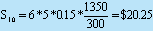
Stockout Costs |
 |
|
| Total
Cost = Carrying cost + Stockout cost = $50.00 +
$20.25 = $75.25 |
|
Therefore: Minimum cost comes from carrying a
10 unit safety stock.
|
|


