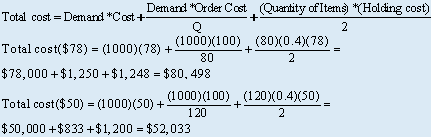
New Enterprise Ltd (NEL) uses 1,000
electric drills per year in their production process. The ordering
cost for these is Mu 100 per order and the carrying cost is
assumed to be 40% of the per unit cost. In orders of less than
120, drills cost Mu 78 per unit; for orders of 120 or more the
cost drops to Mu 50 per unit.
Should we take advantage of the quantity discount?
Q(Mu 78) = (Sqrt (2x 1000
x 100/[(0.4) x(78)]) = 80 Units
Similarly Q at Mu = 50 will be
Q(50) = = (Sqrt (2x 1000 x 100/[(0.4) x(50)]) = 100 Units =120
units to take advantage of quantity discount
Ordering 100 units at Mu 50 per unit is not possible; the discount
does not apply until 120 units are ordered. We need to compare
the total costs for the two alternatives, Q(Mu 78) and Q = 120.
In this situation, the Total Cost equation must include the
cost of the item since this is not a constant.
Therefore, we should order 120 each time at a
unit cost of Mu 50 and a total cost of Mu 52,033. Notice that
Total Holding Cost is not equal to Total Ordering Cost at the
lowest cost alternative (Q = 120) since this is not an EOQ.
|
|