Interesting result on the primary forces
The primary component of the forces above sum upto:
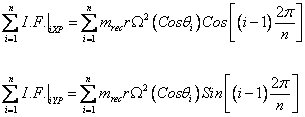 (4.14) (4.14)
Using standard trigonometric relations, it can be shown that this summation simply reduces to (for n > 2):
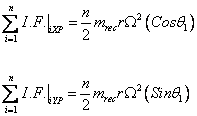 (4.15) (4.15)
Thus, the arrangement of the radial engine has resulted in a total resultant primary force of fixed magnitude viz.,  and directed along the first crank. Thus this fixed magnitude force “rotates” along with the first crank. Such a resultant force can therefore readily be balanced out by an appropriate mass kept on the crank. Therefore it is possible to get complete balance of the primary forces. and directed along the first crank. Thus this fixed magnitude force “rotates” along with the first crank. Such a resultant force can therefore readily be balanced out by an appropriate mass kept on the crank. Therefore it is possible to get complete balance of the primary forces.
Further analysis of the inertia forces reveals that for even number of cylinders (n > 2) i.e., for four, six, eight etc. cylinders the secondary forces are also completely balanced out.
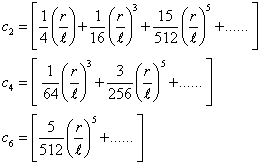
Thus we can have an engine where in all the inertia forces can be completely balanced. Since the reciprocating engines can NOT be normally operated at high speeds because of the inertia forces due to the reciprocating masses, this gives an exciting possibility of operating the radial engine at high speeds. However when we think of high speeds, we should revisit our analysis of the inertia forces. Recall that eq. (5.3) involved an approximation as given in eq. (4.2) wherein we neglected the higher order terms in the series. Including these terms also, we get the more accurate expression for the acceleration of the reciprocating parts as:
 (4.16) (4.16)
where,
 (4.17) (4.17)
Since crank radius “r” is usually less than one-fourth the length of the connecting rod, it is common practice to ignore the higher order terms. However in view of the possibility of higher speeds (i.e. large  ), higher order terms may become significant for a radial engine. Fortunately for even number of cylinders (n > 2) i.e., for four, six, eight etc. cylinders it can be shown that all the higher order forces are also completely balanced out . ), higher order terms may become significant for a radial engine. Fortunately for even number of cylinders (n > 2) i.e., for four, six, eight etc. cylinders it can be shown that all the higher order forces are also completely balanced out .
However as mentioned earlier, radial engines are normally not in use now-a-days. In view of the power-to-weight ratio advantage, gas turbine engines are common in modern aircrafts. However, V-engine configurations wherein the cylinders are arranged in two banks forming a “V” are commonly employed. For example, a six-cylinder engine may have two sets of (three, in-line) cylinders on a common crankshaft arranged as a “V”. Similarly, two sets of the in-line four cylinders of previous example could be arranged on the arm of a “V” to give an eight-cylinder engine. Of course, the larger number of cylinders results in more power. The V-angle introduces additional phase shifts. Typical marine engines use the V-8 configuration.
|


