PITCHING MOMENTS
Due to the axial separation of the cylinders, there is a pitching moment developed about a lateral axis as given by  where where  stands for the axial distance of stands for the axial distance of  cylinder from a common reference frame. When the cylinders are arranged along the length direction of the vehicle, such a moment about a lateral axis of the vehicle tends to induce pitching motion of the vehicle and hence this is known as pitching moment. For the pitching moment to be zero for all crank positions, we can similarly derive the following conditions: cylinder from a common reference frame. When the cylinders are arranged along the length direction of the vehicle, such a moment about a lateral axis of the vehicle tends to induce pitching motion of the vehicle and hence this is known as pitching moment. For the pitching moment to be zero for all crank positions, we can similarly derive the following conditions:
 (4.9) (4.9)
Thus for a given crank shaft profile (i.e., z and  ) we could determine the resultant force/moment on the frame. ) we could determine the resultant force/moment on the frame.
We will illustrate the calculations through an example.
Example: Inline Four Cylinder Four Stroke Engine
Consider an inline four cylinder four stroke marine engine arrangement as shown in Fig. 5.4. Let the reciprocating masses in each cylinder be 500kg. Let the crank length be 200mm and the connecting rod length 800mm. Engine speed is 100 RPM. Investigate its state of balance.
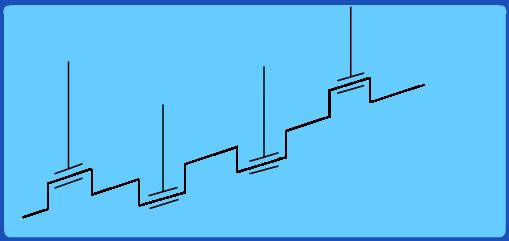
Figure 4.4 Four cylinder In-line engine
Solution:
Let the crank position of the first crank be  . Then the remaining cylinders' cranks are at ( . Then the remaining cylinders' cranks are at (  +180), ( +180) and respectively. In other words, +180), ( +180) and respectively. In other words,  . Thus, . Thus,

Thus the primary forces are completely balanced but not the secondary forces. The magnitude of the unbalanced secondary forces can be estimated as follows:
I.F. = (4) (500) (0.2) (2*  *100/60) 2 (0.2/0.8) = 10966 N *100/60) 2 (0.2/0.8) = 10966 N
Let us take the mid-plane as the reference plane. Then,
 = - 1.5m = - 1.5m
 = - 0.5m = - 0.5m
 = 0.5m = 0.5m
 = 1.5m = 1.5m
Thus, we have,

Therefore the primary and secondary moments are completely balanced.
|


