INERTIA FORCES
Let us designate the inertia forces due to the reciprocating parts of cylinder “i” as  . Thus, . Thus,
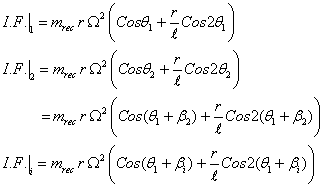 (4.5) (4.5)
These forces are all acting along their respective cylinder axes and are therefore axially separated as indicated in Fig. 4.3. Thus the total inertia force due to the reciprocating parts is given by:
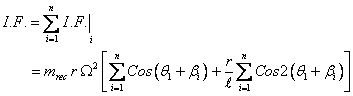 (4.6) (4.6)
where “n” stands for the number of cylinders. From standard trigonometric relations, we can write,
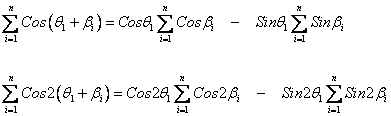 (4.7) (4.7)
In order that the total inertia force be zero for all positions of cranks (i.e., for all values of  ), we therefore have the following conditions: ), we therefore have the following conditions:
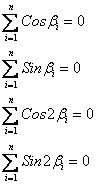 (4.8) (4.8)
|


