Module 9 : Forced Vibration with Harmonic Excitation; Undamped Systems and resonance; Viscously Damped                    Systems; Frequency Response Characteristics and Phase Lag; Systems with Base Excitation;                    Transmissibility and Vibration Isolation; Whirling of Shafts and Critical Speed.
Lecture 3 : Response of base excitation systems
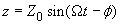
Similarly we can obtain the steady state RELATIVE motion from eqn (9.3.3) as:
 
(9.3.9)
 

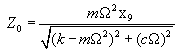
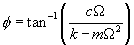
where

(9.3.10)
 
(9.3.9)
  Variation of z (i.e. motion of the mass relative to the base) with respect to the forcing frequency is plotted in Fig. 9.3.4. It is observed that the asymptotes of the response have interchanged when we compare the response to Fig. 9.3.3 i.e., at lower frequencies the relative motion of the mass tends to zero while at high frequencies the magnification factor tends to unity. We will return to this plot at a later stage when we discuss vibration measuring instruments etc.
                                            
                                                                                                   Fig 9.3.4