Module 9 : Forced Vibration with Harmonic Excitation; Undamped Systems and resonance; Viscously Damped                    Systems; Frequency Response Characteristics and Phase Lag; Systems with Base Excitation;                    Transmissibility and Vibration Isolation; Whirling of Shafts and Critical Speed.
Lecture 3 : Response of base excitation systems

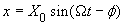
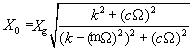
Assuming that the free vibration transients would have died down due to the damping present in the system, the steady state absolute response of the mass can be shown to be:

 
Given
(9.3.4)
 

Assume

(9.3.5)
 
(9.3.6)


Variation of the response with forcing frequency is plotted in Fig. 9.3.3 and can be observed to be very similar to that harmonic force excitation acting directly on the mass itself. If we wish the motion of the mass to be less than that of the ground, then the system natural frequency has to be designed in such a manner that
                                                         
                                                                                                       Fig 9.3.3

 
(9.3.7)
 

This is a very important observation and has several practical implications as indicated below:


Practical Implication

When the suspension of a car is designed, it has to be designed such that the natural frequency of the car is less than about ? or ¼ the road disturbance frequency, which itself depends on the waviness profile of the road surface as well as the forward speed of the vehicle. Typical values for suspension stiffness are in the range of 20 N/mm for passenger cars such that the natural frequencies for vertical oscillation are about 1 Hz. Thus we need to design a “soft” suspension for better ride comfort. Of course there are other constraints (such as vehicle handling) that determine the optimal design of the suspension.