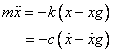
We could choose two sets of coordinates in this problem viz., the absolute motion of the ground and the mass (or) the motion of the mass relative to the ground. Both have practical utility in different contexts and we shall derive the necessary expressions for both at this stage. For example, if we are interested in the ride comfort of a passenger seated in a car, we will be worried about the absolute acceleration felt by the passenger due to road unevenness. On the other hand if we mounted any measuring instrument on a shaking ground, it can measure only the relative motion of the mass with respect to the ground. If we introduce z = x – y as the relative motion coordinate, the governing equation in terms of z can be given as: |