 |
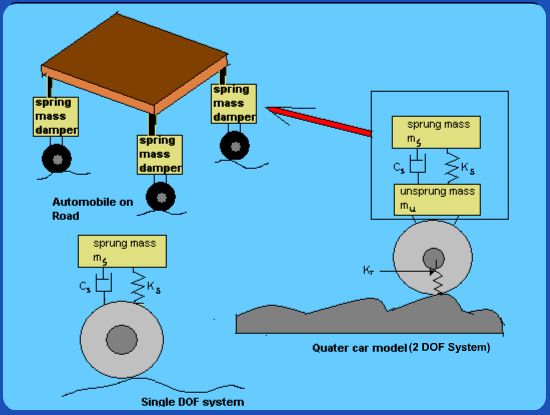
Fig 11.3.1Quater car model
|
| |
In the previous lecture we discussed the response of the single d.o.f system to a sinusoidal force when the force is acting on the mass, such as in the case of an unbalanced machine operating on its springy foundation. Another important practical situation arises for example in the case of an automobile on the road as shown in Fig. 11.3.1. Typical tire stiffness is in the range of 200 N/mm while that of the suspension is of the order of 20 N/mm. Thus assuming the tire to be practically rigid, we can come up with a simplified single d.o.f model of one-quarter of the car as indicated in the figure. In this case, the excitation of interest for the present discussion is the road undulation. Excitations of course arise from the operation of the engine and hence proper design of the engine mounts becomes important but this will be taken up later. The road undulation is represented as a ground motion disturbance input given to the bottom end of the spring. Let us now investigate the response of such “base-excitation” systems. |


