ALL-WHEEL DRIVE HYBRID
For the subsequent discussion, some definitions are necessary: AWD = All-wheel drive, 4WD = Four-wheel drive, 2WD = Two-wheel drive, FWD = Front-wheel drive and RWD = Rear-wheel drive. In the discussion to follow, AWD is used for either AWD or 4WD.
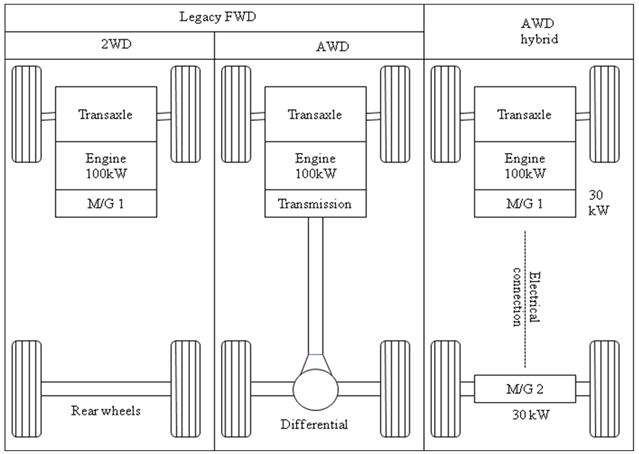 Fig.3. AWD hybrid design starting with an FWD legacy vehicle. The three drawings are 2WD, the conventional AWD, and hybrid AWD.
The design for an AWD hybrid vehicle depends on whether the starting point is a conversion of an existing AWD vehicle or starting with a clean sheet of paper. With conversion of an existing design, the starting point is called the “legacy design.” Many conventional AWD vehicles are sold with the optional choice of either 2WD or AWD. The 2WD is less expensive than the AWD and provides better mpg. The optional 2WD versions may be either FWD or RWD. The 2WD on the left side of Fig.7 starts as FWD. The 2WD on the left side of Figure 4 starts as RWD.
The legacy design affects the loading for the front and rear tires. With FWD, the front tires have three loads:
- cornering
- braking or traction
- steering.
Tires have a load limit. Loads are additive. The rear tires carry, at most, two loads:
- cornering
- braking or traction.
Too much torque to the front wheels may overload the front tires. An overload adversely affects vehicle handling in extremis .
To avoid overloading the front tires, a torque split between front/rear is satisfactory with 50/50 or with a bias on the rear wheels of approximately 30/70 F/R.
The torque split need not be precisely equal to the numbers 50/50 and 30/70; values near these values are satisfactory.