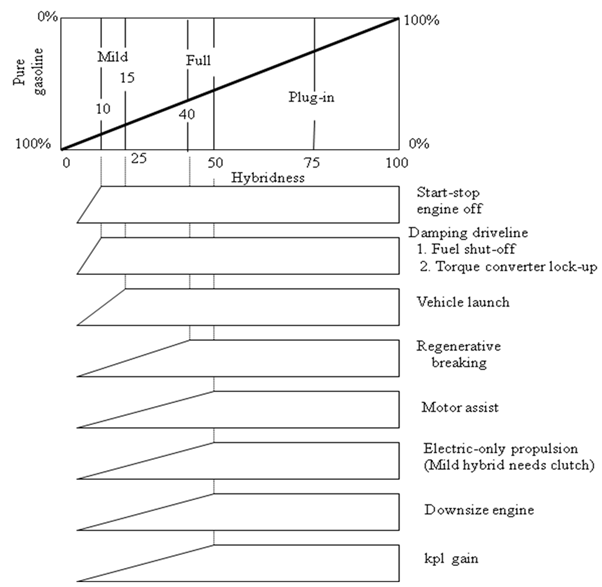
Fig.2. Availability of various techniques to enhance hybrid performance as a function of hybridness and resulting mpg gain. The bar below the hybridness graph has a ramp which extends from H = 0% to a value of H for the particular technology. For start–stop, the ramp ends at H = 10%. The flat bar beyond indicates that for all values of H > 10%, that feature is available to the hybrid designer.
Regenerative Braking
For small values of H , which implies small generator, the Motor/Generator (M/G) set cannot absorb the kinetic energy of the vehicles forward motion in a rapid stop.
Although modest regenerative braking is possible and is used at low H , regenerative braking can only be fully exploited when H is about 40%.
Motor Assist
Vehicle launch is part of motor assist, but applies to very low speed. Motor assist covers a broader range of speed and vehicle operations such as hill climbing and driving in snow. More power and a larger electric motor are required.
Hybridness, H , of 50% yields enough power from the electrical motor to overcome the power deficiencies of the downsized engine.
Electric-Only Propulsion
Electric-only propulsion means the gasoline engine is shut down and does not consume fuel. Electric-only operation improves mpg.
To achieve performance goals, the motor must have adequate power. At H = 50%, the traction motor is as large as the engine. Alone, the traction motor yields the desired performance.
Another reason that electric-only operation is desirable is the fact that emissions are zero or near zero. Stringent emission requirements may be met by electric-only operation. However, cool-down of the catalyst during idle-off is a problem to be solved.
Kilometer per liter gain
As hybridness increases, up to about 50%, mpg (1 mile per gallon = 0.425143707 kilometers per liter) also increases. This is a result of a balance between power required and power available. The increase in mpg possible by plug-in is not shown. Plug-in requires energy from charging stations.
MILD OR MICRO HYBRID FEATURES
As a result of being a mild hybrid, certain features follow. The M/G may be belt or chain driven. Alternatively, the M/G may be part of the flywheel. The M/G serves as the starter/alternator combined.
Mild hybrids have limited regenerative braking. The battery and installed M/G may be large enough to provide low speed motor assist or to provide low speed launch assist. For the rare case of a diesel/hybrid, the M/G in M-mode can provide cold start of the diesel.
For a mild hybrid, other possible design features include fuel cutoff at deceleration, idle shutoff, and torque converter lockup where applicable.
PLUG-IN HYBRID
The plug-in hybrid can be viewed as an EV but with a small engine to extend range. Features of a plug-in hybrid include a large, heavy, expensive battery. The comparison with a full hybrid is a battery of a few 45.36 kg instead of the typical 45.36 kg in a full hybrid.
Additional equipment is needed to connect to external “wall plug” electrical source for recharging. Since batteries are high voltage, the voltage of the charging source must be even higher. Inductive rechargers prevent exposure to high voltage. The plug-in will likely have small gasoline engine driven generator for on-board charging; this engine separates the plug-in hybrid from the EV.
For people willing to undertake the recharging chore, the plug-in offers fantastic mpg. To gain the benefits, the range of hybridness for a plug-in is 50% < H < 100% with H likely to be closer to 100%.