In this lecture the different types of the hybrid electric vehicles are presented. The following topics are covered in this lecture:
- Interpretation of Ramps
- Techniques to enhance hybrid performance
- Mild or micro hybrid features
- Plug-in hybrid
- All-wheel drive hybrid
INTERPRETATION OF RAMPS
The interpretation of the ramps is discussed here. The example used in Figure 1 applies to the capability of hybrids to exploit regenerative braking.
For a mild hybrid, H = 15%, regenerative braking is possible but only about 38% of kinetic energy can be recovered. The calculation is 15/40 = 38%, which is the height of the ramp at H = 15%.
The limitation is due to the small generator. The ramp ends at H = 40% for which a hybrid has a generator large enough to enable high-efficiency regenerative braking.
For a full hybrid, H = 50%, more than enough generating capability exists for regenerative braking. As denoted by the fl at bar, the span of H from 40% to 100% allows full regenerative braking.
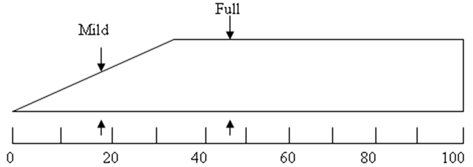
Fig.1. Interpretation of the ramps
TECHNIQUES TO ENHANCE HYBRID PERFORMANCE
As a summary to the hybridness discussion, various techniques to enhance hybrid performance are arrayed with hybridness in Figure 2 .
Start–Stop
Engine-off during stops in traffic affords a saving in fuel. The usual 12 V starter does not have the power to restart the engine without delay, noise, and vibration. With the more powerful electrical motors, even in mild hybrid, the engine rpm can be quickly increased. Once smoothly and quickly up to starting rpm, the fuel injection can be activated.
Damping Driveline Oscillations
Another way that fuel consumption can be reduced is to shut off fuel flow whenever brakes are applied. Abrupt turn off of fuel can cause shudder and unpleasant oscillations of the engine and of driveline. Damping by the electrical motor can decrease the unpleasantness to an acceptable level.
For a hybrid that uses an automatic transmission, some losses in the torque converter can be reduced by locking the torque converter eliminating slippage.
Under some conditions, when the torque converter is locked, driveline oscillations are excited; these oscillations are disagreeable to the customer. Once again, damping by the electrical motor can decrease the unpleasantness to an acceptable level.
Vehicle Launch
An engine at low rpm has little torque. At launch, torque is essential. An electric motor, even a small one, has high torque at low rpm.
The motor fills in the torque hole at low rpm. A small motor can contribute significantly to the initial launch.