Introduction
The topics covered in this chapter are as follows:
- Control Strategies of PM Machines
- Constant Torque Angle Control
- Constant Mutual Air gap Flux Linkage Control
- Optimum Torque per Ampere Control
Control Strategies of PM Machines
There are various control strategies and depending on the application a suitable strategy can be chosen. For example, a mutual flux air gap linkages control gives a smooth transition to flux weakening above the base speed. Similarly, a maximum efficiency control is suitable for applications where energy saving is important such as hybrid and electric vehicles. The most commonly used control strategies are:
- Constant torque angle control
- Unity power factor control
- Constant mutual air gap flux linkages control
- Angle control of air gap flux and current phasors
- Optimum torque per ampere control
- Constant loss based maximum torque speed boundary control
- Minim loss or maximum efficiency control.
The control strategies marked in bold are discussed in the following sections.
Constant Torque Angle Control
Consider that the PM motor is supplied three phase currents given as follows:
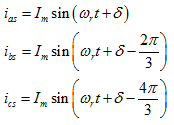 |
(1) |
The q and d axes stator currents in the rotor reference frames are obtained through the transformation matrix as:
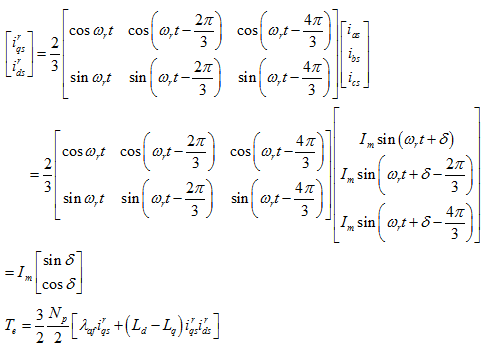 |
(2)
(3a) |
Substituting the values of  from equation 2 into equation 3a gives
 |
(3b) |
Having developed the basic equations, we now focus on the Constant Torque Angle Control. In this strategy the torque angle δ is maintained at 90°. Hence, the above torque equation becomes:
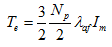 |
(4) |
The q and d axis voltage for the PM machine (refer Lecture 24 equation 16) is given by
 |
(5) |
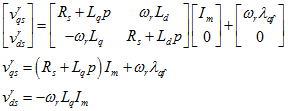
Since the load angle δ = 90°, from equation 2, 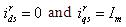 and equation 5 can be written as:
 |
(6) |
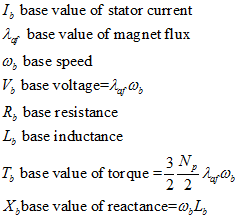
For the analysis of the control strategy, it is convenient to convert equation 4 and equation 6 into per unit (p.u) values. The base values chosen are:
 |
(7) |
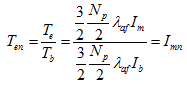
Using the base values given in equation 7 the normalized can be written as
 |
(8) |