|
|
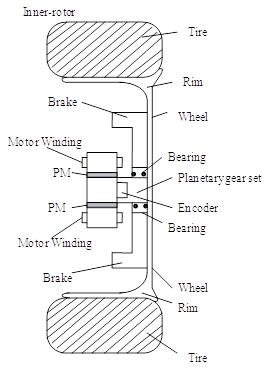
Figure 6a: Inner rotor In Wheel drive |
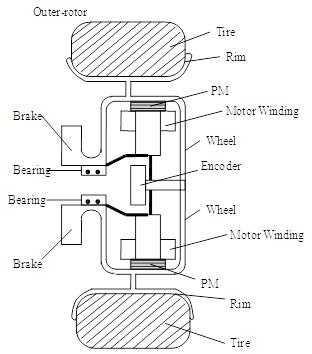
Figure 6b: Outer rotor In Wheel drive |
Considerations of EMs used in EVs
The requirements of EMs used in EVs are:
- • Frequent start/stop
• High rate of acceleration and deceleration
• High torque low speed hill climbing
• Low torque cruising
• Very wide speed range of operation
The EMs for EVs are unique and their major differences with respect to industrial motors in load requirement, performance specification and operating environment are as follows:
- • EV motors need to produce the maximum torque that is four to five times of the rated torque for acceleration and hill climbing, while industrial motors generally offer the maximum torque that is twice of the rated torque for overload operation
• EV motors need to achieve four to five times the base speed for highway cruising, while industrial motors generally achieve up to twice the base speed for constant power operation
• EV motors require high power density as well as good efficiency map (high efficiency over wide speed and torque ranges), while industrial motors are generally optimized to give high efficiency at a rated point.
• EV motors need to be installed in mobile vehicles with harsh operating conditions such as high temperature, bad weather and frequent vibration, while industrial motors are generally located in fixed places.
References:
[1] C. C. Chan and K. T. Chau, Modern Electric Vehicle Technology , Oxford Science
Publication, 2001
Suggested Reading:
[1] I. Husain, Electric and Hybrid Electric Vehicles , CRC Press, 2003
[2] M. Ehsani, Modern Electric, Hybrid Electric and Fuel Cell Vehicles: Fundamentals, Theory and Design , CRC Press, 2005