When the commanded deceleration rate, j/g, is greater than the road adhesive coefficient  , this commanded deceleration rate will never be reached due to the limitation of the road adhesion. The maximum deceleration that the vehicle can obtain is
 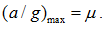 . The operating point of the front and rear braking forces is on the curve I, corresponding to μ( μ=0.4 and j/g>0.4 and in Figure 2, for example); the operating point is point k and the maximum deceleration rate is j/g=0.4.
It should be noted that the series brake with both optimal feel and energy recovery needed active control of both electric regenerative braking and mechanical braking forces on the front and rear wheels. At present, such a braking system is under research and development.
Parallel Brake
The parallel brake system includes both an electrical (regenerative) brake and a mechanical brake, which produce braking forces is parallel and simultaneously. The operating principle is illustrated in Figure 3 , in which regenerative braking is applied only to the front wheels.
The parallel brake system has a conventional mechanical brake which has a fixed ratio of braking force distribution on the front and rear wheels. Regenerative braking adds additional braking force to the front wheels, resulting in the total braking force distribution curve. The mechanical braking forces on the front and rear axles are proportional to the hydraulic pressure in the master cylinder. The regenerative braking force developed by the electric motor is a function of the hydraulic pressure of the master cylinder, and therefore a function of vehicle deceleration. Because the regenerative braking force available is a function of motor speed and because almost no kinetic energy can be recovered at low motor speed, the regenerative braking force at high vehicle deceleration (e.g., a/g=0.9) is designed to be zero so as to maintain braking balance. When the demanded deceleration is less than this deceleration, regenerative braking is effective. When the braking deceleration commanded is less than a given value, say 0.15g , only regenerative braking is applied. This emulates the engine retarding in a conventional vehicle. In Figure 3 , the regenerative braking force, , and mechanical braking forces on the front and rear wheels,
 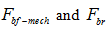 , are illustrated.
Figure 4 shows the total braking force, regenerative braking force, and mechanical braking force on the front wheels as well as the braking force on the rear wheels in the parallel braking system of a passenger car.
The parallel braking system does not need an electronically controlled mechanical brake system. A pressure sensor senses the hydraulic pressure in the master cylinder, which represents the deceleration
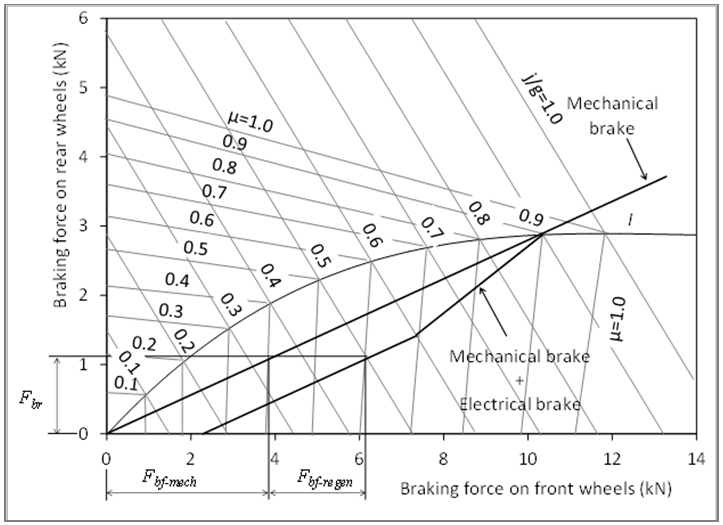
.......................................................Figure 3: Illustration of parallel braking strategy [1]