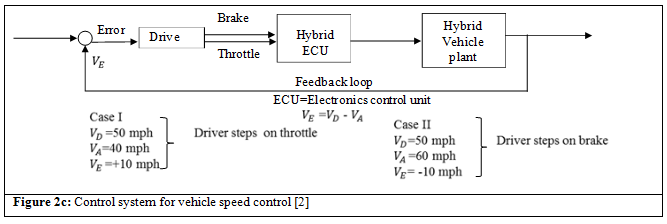
A modern control system for HEV may use only a few feedback control loop similar to the one shown in Figure 2c . The control architecture shown in Figure 2c uses a single feedback loop and has desired velocity as the variable being controlled. The driver is one of the control elements and acts on the error. If the HEV is moving too slowly, the driver steps on the accelerator pedal and it the vehicle is too fast, the driver steps on the brake pedal. The hybrid ECU is the master controller and it controls the other subcomponents of the vehicle such as ICE, EM, power electronics, etc. The detailed discussion on the complete control architecture is discussed in next section.
 Overview of Control System: The Electronic Control Unit (ECU)
Typical control architecture of HEV is shown in Figure 3 . In Figure 3 it can be seen that there are multiple ECUs such as:
i. Hybrid ECU
ii. ICE ECU
iii. EM ECU
iv. Transmission ECU
v. Power Electronics ECU
vi. Battery ECU or Battery Management System
A brief description of each of the ECUs is given below.
Hybrid ECU : The Hybrid ECU is in command of all other ECUs and selects the operational mode based on the driver's input. The hybrid ECU is responsible for system wide energy management. Typically the goal of control is to minimize the fuel consumption. For each litre of petrol, the hybrid ECU tries to provide maximum mileage. To do this, the hybrid ECU allows or prohibits ICE shutoff. The hybrid ECU commands
- the amount of torque and power from the motor and ICE
- the amount and timing of power generation to charge battery.
ICE EMU : This controls the various ICE parameters discussed in previous section
EM ECU : The EM ECU is responsible for switching of the EM from motoring mode to the generator mode and also controls the motor to deliver the torque demanded by the hybrid ECU. The EM ECU consists of various control strategies such as Constant Torque Control, Field Weakening Control, etc.
Transmission ECU : The transmission ECU provides the correct gear ratio to control the torques and angular speeds of the EM and the ICE.
Power Electronics ECU : Having power from a battery is only the first step. The power must be delivered to the EM, in the motoring mode, at the voltage and current needed. For regenerative braking, the power must be accepted from the EM. The function of the power electronic ECU is to receive commands from hybrid ECU, to control inverter energy flow both ways, that is, charge and discharge, to control switching of EM between motor and generator modes and to control switching of EM between motor and generator modes.
attery ECU or Battery Management System : The battery ECU or the battery management system (BMS) monitors and measures temperature and assures cooling is adequate. The BMS avoids the stress of heat and over-temperature and the effects of excessive charging or discharging are eliminated or lessened. The BMS is essentially for long battery life and optimum fuel efficiency.