Introduction
The topics covered in this chapter are as follows:
- Function of Control System in HEVs and EVs
- Elementary of Control Theory
- Overview of Control System: The Electronic Control Unit (ECU)
- Control Area Network
- Control Variables
Function of the Control System in HEVs and EVs
The major functions of the control system are:
i. to maximize the fuel efficiency
ii. to minimize the exhaust emissions.
The fuel efficiency and emissions are mutually conflicting and some of the reasons why this happens are:
i. when more energy is extracted by the ICE (thereby increasing the ICE efficiency) the exhaust temperature goes down. At lower temperatures, the chemical reactions associated with the combustion of unburned hydrocarbons may not occur.
ii. Increase in compression ratio, which enhances fuel economy, also raises temperature in ICE. Increased temperature increases both CO and oxides of nitrogen represented by NOx.
The minor functions of the control system are component monitoring and protection such as:
i. battery state of charge (SOC) monitoring
ii. Battery temperature monitoring
iii. EM overheating
iv. ICE overheating
The battery merits special attention to avoid failure and to assure long life. The control system generally provides a fail safe mode in the event of failures. This gives a limp-home capability that helps the manufacturer to retain some credibility with the customers.
One of the functions of control systems, which is minor in cost but valuable in practice, is onboard diagnostics (OBD).
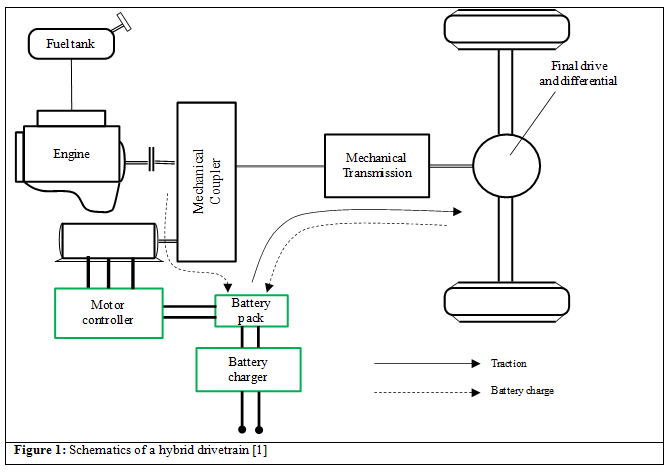
In Figure 1 , a simple HEV drivetrain is shown. For the HEV drivetrain shown in Figure 1 , the complexity of the control system used in HEV may be appreciated by considering the various operational modes ( Table 1) and the interplay between many components. The switching from one mode to another must be as smooth. As the HEV's operation mode changes, several parameters of the ICE that have to be controlled are:
i. Ignition timing
ii. Tuned intake manifold
iii. Camshaft angle for exhaust valves
iv. Camshaft angle for intake valves
v. Fuel injector settings which includes
vi. Timing of injection
vii. Fuel flow rate