Elements of Control Theory
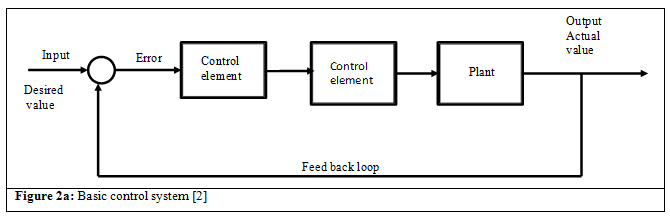
The basis for control is the feedback loop shown in Figure 2a . The input is the desired behaviour of the system and it is compared with the actual behaviour to determine the error signal. The error signal is fed into one or more control elements that move actuators at the plant. The word “plant” is the name for the object being controlled. The actual value of the controlled variable from the plant is transmitted via the feedback loop to the summation loop.
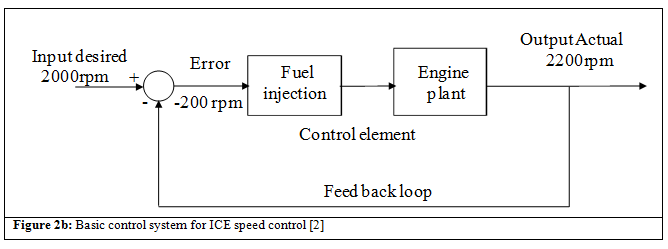
In Figure 2b a simple example of ICE control is shown with its control element and plant. The control element is a general term and identifies the elements that receives the error signal and change the plant's behaviour. In Figure 2b the fuel injector is the control element and the ICE is the plant. To understand the working of the control system, shown in Figure 2b, let us assume that the desired speed of ICE is 2000 rpm and the actual speed is 2200 rpm. An error signal of -200 rpm is generated and this negative error signal is fed to the fuel injector. The fuel injector responds to the negative error by decreasing the flow of fuel to the ICE. With less fuel, the speed of ICE drops.