2.3 Controller with Observer
The observer dynamics:

Combining with the system dynamics
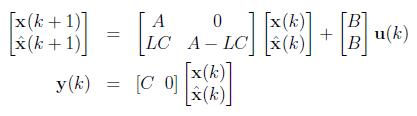
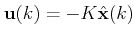
Since the states are unavailable for measurements, the control input is
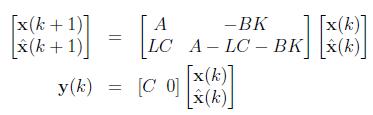
Putting the control law in the augmented equation
The error dynamics is

If we augment the above with the system dynamics, we get
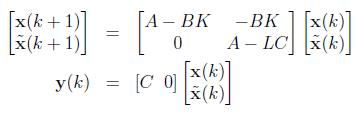
where the dimension of the augmented system matrix is R2nx2n . Looking at the matrix one can easily understand that 2n eigenvalues of the augmented matrix are equal to the individual eigenvalues of  and
and  .
.
Conclusion: We can reach to a conclusion from the above fact is the design of control law, i.e., is separated from the design of the observer, i.e., .
The above conclusion is commonly referred to as separation principle .
The block diagram of controller with observer is shown in Figure 3.
![\begin{figure}\centering
\begin{pspicture}(-2,-2)(12,8)
%\pnode(-1,6){u}\rput(...
...B=180]{-}{u1}{a2}
\rput(4,-0.7){$\mathbf{u}(k)$}
\end{pspicture}
\end{figure}](images/img72.png)