Computation of observer gain matrix L
The task is to place the poles of  . Necessary and sufficient condition for arbitrary pole placement is that the pair should be controllable.
Assumption: The pair  is observable. Thus, from the theorem of duality, the pair
  is controllable.
You should note that the eigenvalues of 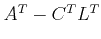 are same as that of
  . It is same as a hypothetical pole placement problem for the system
  , using a control law
 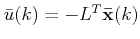 .
.
Example:
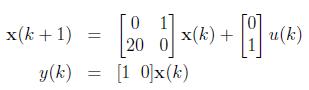
The observability matrix
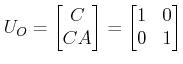
is non singular. Thus the pair is observable. The observer dynamics are

L should be designed such that the observer poles are at 0.2 and 0.3.
We design LT such that has eigenvalues at 0.2 and 0.3.
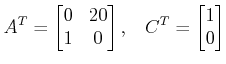
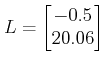
Using Ackermann's formula, ![$ L^T = [-0.5 \;\;\; 20.06]$](images/img57.png) . Thus
. Thus