Nyquist plot of GH(z), as shown in Figure 3, intersects the negative real axis at -0.025K when 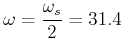 rad/sec.
 can be computed as

It can be seen from Figure 3 that for to be -90°, (-1, j 0) point should be located at the left of -0.025K point. Thus for stability
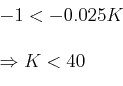
If K > 40, (-1, j 0) will be at the right of  point, hence making
  .
.
If , we get from (1)
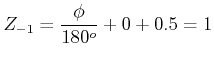
Thus for K > 40, one of the closed loop poles will be outside the unit circle.
If K is negative we can still use the same Nyquist plot but refer (+1, j0 ) point as the critical point. in this case still equals +90° and the system is unstable. Hence the stable range of K is 0 ≤ K < 40
More details can be found in Digital Control Systems by B. C. Kuo.